Sunday, March 23, 2014

Conclusion of Ham on Rye

Ham on Rye is a harsh, extremely blunt commentary on a lot of issues in 1930s America. I don’t think 20th century literature has seen such an angry, confused, bitter character as Henry, who is the alter ego of the author.
And indeed, who would not be these things if your father beat you regularly for missing a few blades of grass when mowing the lawn, or having such extreme acne that you were quarantined for months and no one wanted so much as to lay eyes on you.
I kept expecting a breakthrough of some sort throughout the story, that the character would find in some sense, a purpose or at least if he was going to be eternally against everything, he would at least be content in the role he chose, but the story feels so unresolved.
I suppose this style of writing is very much in keeping with the Russian authors that Henry immersed himself in such as Maxim Gorky, Ivan Goncharov, and others, and having read some of this literature, I can understand how Henry connected their message to his life. The lack of hope for the common man and lack of opportunity because of limited income certainly is a theme in our class readings and in this book.
Even though this book was difficult to read and while Henry certainly does not embody the traits that a protagonist usually demonstrates (honor, decency, etc.) I find that I still like aspects of his character, such as his honesty and absolute fearlessness about what others think about him. I’ve never encountered a character so utterly indifferent to punishment once he sets his mind on something.
And while this book did not end with a resolving conclusion or give closure to the events of the story, at least the person who was at the center of the story all along (the author) did go on to become a famous writer and hopefully find some justice after all.

Tuesday, March 18, 2014

Ham on Rye...or Expletive on Expletive

Well, where does one begin when a story is completely saturated with every variety of profanity, vulgarity, et cetera? I'm not entirely sure, and since I am not prepared to tackle young Henry's escapades through sexual awakening and violent tendencies, I will focus on some of the other themes in the reading.
It's interesting that Henry, who has very violent, very disturbing impulses also feels things very sensitively. When neighborhood boys are gathered around, watching a spider devour a fly, Henry destroys the web, saving the fly, much to the consternation of his companions. Later on, Henry experiences fierce pangs of helplessness, feeling nausea because his friends are torturing a cat and he is too scared to intervene. His thought is that  'the cat didn't have a chance against humanity' and you can almost hear his next thought being that he doesn't have a chance against the persons in his life.
It also goes without saying that a group of fifth graders who daydream about violent sex with older women are obviously way older than their age(and seriously messed up as well), and this is a huge theme throughout the book. Henry even says that when he is describing how the kids are sullen and even controlling of adults at their school and in the community. The times have made them impatient with their adolescence.
 While the depression isn't a central theme, it is definitely appearing in the peripheral of the story, with the children's fathers losing jobs and a general lack of money. It seems as if even Henry's parents' compulsion of having roast beef every day has been thwarted by poverty.
Food did not seem to play any sort of role in this portion of the book, I am curious to see how it will in the coming chapters; that is, if the there is any room left over after 50 pages worth of sex, expletives, violence, older women....you get the idea.

Saturday, March 15, 2014

Ham on Rye

This story starts in 1922, in Germany and is told from the perspective of a young boy, Henry Buskowsi. Even his earliest memories are of discord in his family. His father is controlling and hateful, his mother a passive observer, and his grandmother a bitter, hateful person. This scenario does not bode well for young Henry. The family moves to L.A. where Henry enrolls in a hostile school and the family is distant from the rest of the community. Even though Henry's family is of the same income bracket as the rest of the neighborhood, his parents consider themselves better than their neighbors and forbid Henry to play with the other children. It would seem as though this family did not have the corner on hate, as the children at school bully any child who is weak or otherwise vulnerable, making Henry's existence a living nightmare. 
One of the most disturbing elements of the reading is Henry's inability to express himself. His father does not wish to hear his son communicate, saying that children should be seen and not heard. One of the family's relatives perceptively noted that 'still waters run deep', referring to Henry and I think that insight will be prophetic as the story progresses. 
Even this early in the book, I can tell that I haven't read anything remotely resembling this narrative. It is crass, harsh, and offers a version of reality that no one would desire. I am curious to see where the author takes young Henry, but I must say, I am not too optimistic about the boy's future.

Tuesday, March 11, 2014

Character contrasts in the Hunger Games

This book was impossible to put down, with its ceaseless suspense and cutting insights into today’s culture. Like many, I completely fell in love with the tenacity and determination of Katniss and I am curious to see how she develops in the next several installments in the series. 
One of the most interesting aspects of Collin’s story is the contrasts between Katniss and Peeta; both are thrown into the ring, and both are fighting to survive and yet their strategies are radically different. Katniss immediately alienates the ‘career group’ and strikes out on her own while Peeta works the career group and befriends them, to protect himself and Katniss. Katniss is uninterested in people, Peeta works situations and people for his benefit. I found this two approaches very interesting; during the first part of the Games, Peeta seemed weak to me. Compared to Katniss’s impressive skill set and tenacity, Peeta with his cake decorating abilities, did not seem like a comparison.


However, Peeta is strong and brave as well; he warns Katniss when the careers are coming after her and part of his involvement with the group is to protect Katniss. His level head and strategy is quite impressive, especially considering how violent those tributes were. 

This contrast illustrates that strength comes in many forms and bravery is not always demonstrated by fighting.

Saturday, March 8, 2014

The role of violence in the Hunger Games

Having finished Hunger Games, I can say that I think the author had a dual purpose; to draw some parallels to modern society and to write one heck of a suspense novel.  When asked about the vivid violence portrayed in the book, Collins said that she wants young people to consider the brutality of war. She also questions how the younger generation is spending their time. “What’s your relationship to reality TV versus the News?”, was her query to persons my age. 
I appreciate Collin's concerns about how we view violence and where we seek our opinions. I hope that readers consider violence and its place in our society. I also am intrigued by the fact that if it wasn’t for the violence portrayed in this series, it wouldn’t be nearly as popular.
Let me explain that statement.
When the Hunger Games came out, they became immediately known by their controversial plot line: the brutal games that pit adolescents against each other in a desperate fight for survival. It wasn’t so much the violence that was portrayed in the books that bothered me so much, it was the fact that people were reading the book in droves because of this unusual storyline. The ‘bait’ so to speak was the violence portrayed.  
My concern about this is that the real message of the Hunger Games is not forgotten; unmitigated violence is a terrible evil, especially when used by a government to control others.  I think that violence can control us and when we read a novel like the Hunger Games just hoping for entertainment, it does just that.
 http://www.independent.co.uk/arts-entertainment/films/features/suzanne-collins-hunger-games-trilogy-speaks-to-a-generation-of-teenage-readers-like-no-other-literary-creation--but-whats-the-big-message-8958113.html

http://hungergamesmovie.org/13082/author-suzanne-collins-on-the-heavy-message-of-the-hunger-games/

http://www.imdb.com/title/tt1392170/reviews

Tuesday, February 25, 2014

Entering the Capital

Katniss Everdeen is a spunky, stubborn, and determined sixteen year old who has been taking care of her family since her father's death. Since then, she has braved punishment at the hands of the so called 'peacekeepers' who hold all twelve districts in a choke-hold of fear by escaping her district's limits and foraging in the woods to feed her family. This perilous existence has remained unchanged; until now. When her frail younger sister's name is drawn in the annual 'Hunger Games', a tradition devised by the ruthless capital to hold districts in fear, Katniss volunteers herself as tribute. Taking the place of her sister, she and a boy she knows only vaguely, Peeta, are taken to the capital to 'be trained in the art of survival' and to undergo frivolous makeovers to entertain the capital audience. And while Peeta genuinely seems to care about Katniss, she knows that only one tribute will leave alive. And she is determined for the sake of her mother and sister that that person will be her.
There are many commendable character traits to admire in Collin's cast of characters. Katniss is fiercely devoted to her family and will stop at nothing to protect them, even risking her own life to do so. Her alliance and friendship with Gale, a boy from her district is also to her credit; they meet while foraging for food and decide to look after one another and their families.
This story, with all of its rampant injustice reminds me of Rigoberta Menchu's testimony. I remember being struck with the strength and beauty of her spirit and the characters from this book are no different. Sometimes in the midst of the greatest evil, light is most visible.

Sunday, February 23, 2014

Jurgis: A 20th century migrant worker

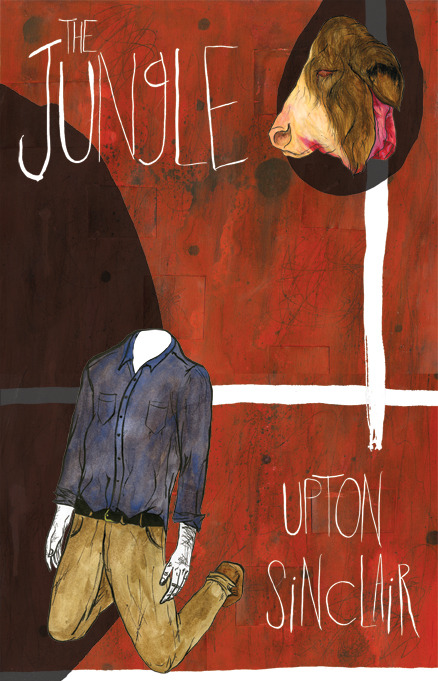
Chapters 21 through 26 fulfill all of the foreshadowing of gloom present in the first five chapters. Many things have changed since the innocent, naïve, Jurgis, Ona, and their family arrived in Chicago. Jurgis has lost his job at the slaughterhouse because an injury prevented him from working for three months and his employers won’t take him back. Ona died during the premature labor of their second child and Jurgis is weary and embittered. After his child drowns in the street, Jurgis deserts Teta  Elzbieta and the family, becoming a tramp. Even after everything Jurgis has suffered physically and emotionally, he is still a fine worker and the farms where he pays for meals all offer him seasonal work. Jurgis, now no stranger to the ways of the system, refuses, knowing he will be out of work as soon as the winter comes.
While Jurgis is traversing the countryside, he meets many tramps some who work, but many of whom beg or steal. Jurgis has reached the point where he knows that as an honest man and worker he will never get ahead. This point reached, he does whatever he can to survive.
The necessity of winter forces Jurgis back to Chicago where he finds work digging freight tunnels. After another injury and a hospital stay, he again loses his job and becomes a beggar. When a rich and very drunk young man gives Jurgis one hundred dollars, Jurgis can’t believe that something actually worked out. This feeling quickly dissolves when in the attempt to get change; Jurgis is swindled by a bartender. After a fine and a short jail stay, Jurgis encounters Jack Duanne again, and the two partner in a life of burglary and crime.
This leads to working for a corrupt political boss, and enables him to earn eleven dollars a week, go to music halls, saloons and to ‘wear a linen collar’. His life settles into a routine until he happens upon Phil Conner, the man who raped his wife. Attacking the man and beating him lands Jurgis into trouble again, losing his job, and all meager political connections.
In the earlier section of this reading, Jurgis’s travels through the country, encountering farms that will turn him off the minute the harvest is in is so reminiscent of migrant workers today and our class discussions. After our discussions and this reading, I think one of the greatest crimes against humanity is withholding the fruits of a person's labor and not giving them what they have rightfully earned. How horrible that this continues today.